


 2 Player
 Action
 Adventure
 Basketball
 Bike
Bike Car
Car Cooking
 Editor's Choice
 Fight
Fight Girl
Girl iO
iO Kids
Kids Multiplayer
 No Ads
 Platform
 Puzzle
 Racing
 Retro
Retro Shooting
 Skill
Skill Soccer
 Sports
 Stickman
 Strategy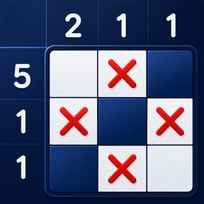




Nonogram Daily provides users with a soothing and logical brain teaser experience using numbers as clues, solving grids and revealing pictures. Every puzzle begins with an empty grid, but both horizontal and vertical lines provide information on which squares will be filled. Users don't have to guess what goes where, they simply interpret the clues, check for patterns, remove empty squares, and gradually reveal the picture hidden in the grid. While it is relatively simple to understand the mechanics of the puzzle, finding the solution after completing a puzzle always seems satisfying due to the fact that it was found through careful thinking.
Gameplay control overview
- Use MOUSE and LEFT-CLICK
Overall view of the game
Nonogram Daily is a picture logic puzzle game. In this game, all decisions are based upon numbers. The clues provided next to each row and column give you the amount of filled-in cells in a particular line. If there is more than one number given as a clue, these groups must be separated by at least one empty cell. Combining row and column information allows you to complete the grid and eventually reveal a pixel-image.
The charm of a nonogram puzzle lies within the perfect balance between being easy to learn while providing an opportunity for deeper reasoning. Although the basic premise of nonogram is easily learned, larger grids may require you to think carefully before making each placement. Due to this reason, the game is ideal for individuals seeking to relax their mind with a simple brain teaser or seek out a daily online challenge in the form of a puzzle that rewards patience over speed.
In addition to having a daily structure, the game has a natural flow. A player can come back to a new grid, improve their deductive skills and take a brief moment to relax and recharge their mind. Whether you are a fan of Nonograms or if you are looking for an introduction to this style of puzzle, the game features a simple approach to creating step-by-step solutions to nonogram patterns.
Other important gameplay elements
- Identify cells that should be filled in using the row and column clues.
- Fill empty cells with X marks to maintain organization of your puzzle.
- Uncover hidden pixel-style images once you correctly fill in the entire grid.
- Experience calm logic-based gameplay without needing rapid reflexes.
- Match clues from both directions in order to confirm specific placements.
- Provide yourself with daily-style puzzles that promote consistent practice.
Recommendations for new players
- Begin with the largest clues since they typically provide the easiest confirmed cells to identify.
- Place x's on spaces that cannot be filled in order to avoid confusing them later.
- Compare each filled square with both its row clue and its column clue.
- Do not begin filling in cells prematurely. Wait until a move is supported by clues.
Advanced Strategies for more experienced players
- Utilize overlap logic when a large clue can potentially cover multiple possible locations, however, it covers some of the same cells.
- Divide completed group clues using X marks to avoid accidentally adding additional cells.
- When you get "stuck", switch from analyzing rows to analyzing columns and see if any clue has become clearer.
- Carefully utilize smaller clues since they are most effective in dividing larger groups in difficult puzzles.
Common errors that are often committed by new players
- Placing squares because they appear likely rather than proving it with clues.
- Neglecting to remember that different group clues must be separated by at least one empty space.
- Overlooking X marks that can make larger grids much harder to read.
- Only solving either rows or columns without checking both ways to find clues that support each other.
Closing comments
Nonogram Daily functions well because it transforms an otherwise straightforward grid into a reflective puzzle solving experience. Each identified filled square contributes toward unearthing the previously concealed image, and each solved puzzle is considered a reward for diligent logic. As part of Rocket Games' catalog, it is a solid option for fans of daily puzzles, calming brain teasers and clean number-based challenges.
Games similar to this one
If you appreciate puzzles that rely on careful consideration, attempt Scrabble Online. It is designed as an interactive word puzzle that focuses on vocabulary and strategic planning. To engage in another classic logic-based experience similar to Nonogram daily, consider attempting Sudoku. Sudoku is a numerical-based puzzle where users attempt to locate specific numbers in designated areas. Lastly, if you favor shorter daily word-based challenges, consider playing Wordle. Wordle is designed as an interactive word-based puzzle with five letters per challenge.
FAQs About Nonogram Daily
What is Nonogram Daily?
Nonogram Daily is a daily picture logic puzzle where users utilize number clues to fill in a grid. Once all of the necessary cells are filled in, the resulting grid displays a previously hidden image.
How do I play Nonogram Daily?
Interpret the clues located beside each row and column, place filled-in squares that are confirmed, and eliminate empty spaces marked with x. Compare both directions until you have successfully uncovered the hidden image.
How many sides does a Nonogram Daily puzzle have?
There are four sides to the grid itself; however, the main clues are generally located on two sides: above the columns and beside the rows. Both types of clues must be compared in order to develop a successful solution.
Are Nonograms good for your brain?
Nonograms can serve as beneficial mental stimulation since they incorporate logic, pattern identification, focus, and problem-solving. While Nonograms are calming, they also present opportunities for careful thought.
How many levels are there in Nonogram Daily?
The number of levels varies according to the specific edition of Nonogram Daily. Most daily puzzle games emphasize delivering fresh grids and frequent challenges versus establishing a set number of levels.
What do the numbers represent in Nonogram Daily?
Each number represents how many consecutive filled-in squares exist. If there are two or more numbers listed, these groups must have at least one empty square separating them.
Are Nonogram Daily puzzles similar to Picross?
Yes. Nonogram, Picross, griddlers and Japanese crossword are terms commonly referred to as this genre of picture logic puzzle.