


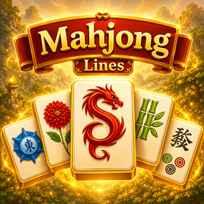


Mahjong Lines is a pathfinding puzzle. Players take all the traditional tile symbols from Mahjong and lay them out on a flat board. Then they study the board looking for two identical tiles in order to connect those tiles through open space. Once connected through open space, the player gets to remove both tiles. However, the line connecting two tiles cannot bend back on itself more than a certain amount. So each time the player finds a match, they are asked to think about how to get to the second tile with the least amount of bends.
Key Controls
- Use MOUSE and LEFT-CLICK
Overall Game Description
The overall description of Mahjong Lines is a single player tile linking challenge based upon the standard Mahjong Connect tile linking rules. As in Mahjong Connect, two matching pieces disappear only if there is a clear line that joins them (that does not cross over another piece) and also does not exceed a certain number of turns. The total number of turns a player's path may include is limited; therefore, the player must think about what route they wish to take in order to link their tiles together. This limits the number of options available to the player at any one time.
Strategy
Most of the strategy behind Mahjong Lines comes from this rule. If a player has two tiles next to each other that appear very close together, it may seem like they should be linked together quickly. However, it is possible that there are tiles blocking the player's access to these tiles, limiting the route that can be taken. On the other hand, a player may see two tiles that could potentially be linked together that are located across the board from each other. These tiles may actually end up being part of a larger sequence of links after several other tiles are cleared. Every time a player successfully connects a pair of tiles, it opens up new potential sequences for other tiles.
As players continue to complete levels within Mahjong Lines, the complexity of the level increases, however, the pace never gets too fast. Therefore, players do not feel rushed, so they can visually examine the tiles, visualize possible lines between tiles, and plan their next step before selecting a pair of tiles to link. In terms of aesthetics, traditional style tile designs such as bamboo, wind, and dragons provide Mahjong Lines with a typical look and feel of the original Mahjong game without requiring players to follow the rules of the competitive 4-player table top game.
Gameplay Key Features
- Tile pairing gameplay with classic Mahjong styled symbols
- Path-clearing rule allows no more than 2 turns
- Boards come in many configurations with increasing difficulty
- Tools (Hints & Shuffles) help in difficult positions
- Pacing is relaxed and focused on logical visual thinking vs. quickness
- Simple point-and-click/ touch-screen interface
Tips for New Players
- Connect tiles on the corner or along the edges first.
- Examine any possible paths that might exist outside of the main board configuration.
- Choose pairs that will unblock multiple other tiles immediately after they are removed.
- Only use Hints when careful viewing will no longer reveal a solution.
More Advanced Tips
- Think two or three steps ahead when removing pairs of tiles instead of just selecting the first visible pair.
- Removing long border sections early on will allow you to create additional paths to work with around the board.
- Select pairs of tiles that will split large areas of congested space into smaller areas.
- Use shuffling only when the current layout leaves you with little chance to make significant progress.
Common Mistakes
- Choosing two tiles that are identical without considering whether or not there is enough room to bend your way to them results in failed attempts at clearing tiles.
- Clearing random pairs will often result in trapping important tiles deep inside congested space near the center of the board.
- Using every tool at your disposal at an early stage will make later stages much harder to recover from.
- Not taking advantage of paths existing around the perimeter of the board may lead to missing opportunities for easy solutions.
Frequently Asked Questions (FAQ)
What is Mahjong Lines?
Mahjong Lines is a single player tile-connection puzzle that utilizes Mahjong symbols for tiles and requires finding identical symbol tiles and creating a line between them through open space to clear the board.
How do I play Mahjong Lines?
Select two identical tiles. Those tiles will be removed once a line exists between them and does not intersect another tile and only includes two bends (turns).
Is Mahjong Lines similar to traditional Mahjong?
No. While it uses traditional Mahjong styled symbols and follows basic tile-pairing concepts, it is primarily a single-player puzzle-based game centered on drawing lines between symbols versus a competitive four-player table-top game.
Why cannot two identical tiles be connected?
There may be obstacles blocking the direct path between two tiles, or simply there isn't enough space to draw the required number of bends (turns). Clearing some of the tiles adjacent to the target area may ultimately expose a viable path.
What strategy would you recommend for Mahjong Lines?
Try starting near edges. Make open pathways. Choose pairs that ultimately will unlock multiple future matches versus simply removing isolated pairs randomly.
What are Hints/Shuffle?
HINT shows an accessible pair of matching tiles. SHUFFLE rearranges remaining tiles. Both tools are useful when a particular level becomes difficult to decipher.
Final Thoughts
One of the reasons Mahjong Lines works well is it provides a simple rule set (match two) with great depth (every removed pair opens a new pathway and every congested section becomes more manageable once the correct connection is made.) Additionally, its casual pace, recognizable symbols and thoughtful path requirements create an enjoyable experience for players who appreciate slow-paced logic puzzles.
Some Popular Mahjong Games
If you would prefer a more traditional experience with a focus on simply removing tiles based upon exposing pairs as seen in traditional Mahjong games, then please try Mahjong Classic. Cozy Mahjong features a softer environment and relaxed board clearing. For players interested in spatial matching with a different view-point, please try Mahjongg Dimensions which incorporates a rotating 3D model of your board.